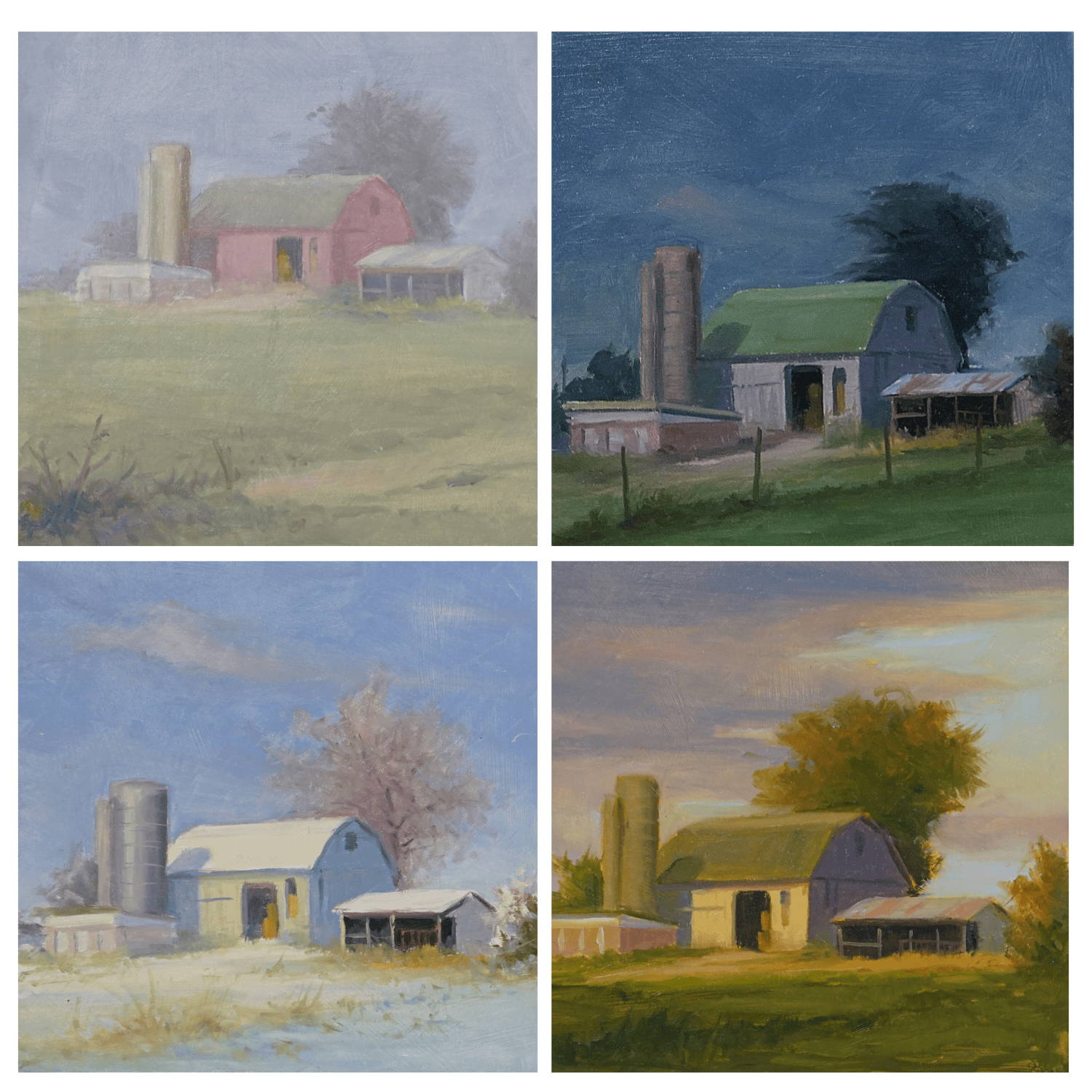
John introduces the weathered barn and silo he will paint four separate times — golden hour, moonlight, snow, and fog — using the same three primary colors, plus black and white. One reference photograph. Four completely different days.

Watch One Ordinary Landscape Become Four Unique Paintings — Golden Hour, Moonlight, Snow, and Fog — Without Changing Palettes!
ARC Living Master John Pototschnik reveals the “backward” order of operations most artists follow. Choose the mood first, then let color follow for harmonious, emotionally moving paintings every time.
HURRY, DISCOUNT ENDS SOON!
Available in both Streaming and DVD Formats
00Days
00Hours
00Minutes
00Seconds
One of the biggest challenges among artists is being unable to put the feeling of a scene onto the canvas.
You can render the barn accurately. Sound drawing. Believable perspective.
And the painting still comes out flat.
Because what moves a viewer is never the subject alone. It’s the atmosphere around it: the quality of the light, the hush before evening, the cold weight of a winter afternoon.
Why they buy art.
Why collectors want a piece in their homes.
A great painting doesn’t show people a place. It puts them there.
Now, the problem is getting that moment right…
…and most artists have been solving it in exactly the wrong order.
You study the reference photo. You mix toward the colors you see, matching what the camera recorded. And somewhere in the matching, the feeling quietly disappears.
So the conclusion arrives: I must be missing a color. Another tube joins the drawer. The paintings don’t improve, because more pigment was never the missing piece.
Choose the mood first.
Establish the value structure that carries it.
Then let color bring it to life.
“It’s value, not color, that creates a painting’s mood. Color only enhances it.”
— John Pototschnik
Most instruction stops before explaining that.
But John proves it.
He does it by holding everything still except the mood.
One summer photograph of a landscape with a weathered barn.
Three primary colors, plus black and white. Four unique paintings.
There was no snow that day. No fog. The moon never rose. The sun wasn’t setting.
But … look again.
Before we get into the details, let’s get to know John a little better!
But John proves it.
He does it by holding everything still except the mood.
One summer photograph of a landscape with a weathered barn.
Three primary colors, plus black and white. Four unique paintings.
There was no snow that day. No fog. The moon never rose. The sun wasn’t setting.
But … look again.
Before we get into the details, let’s get to know John a little better!
Available in both Streaming and DVD Formats
Meet Your New Instructor
John Pototschnik!
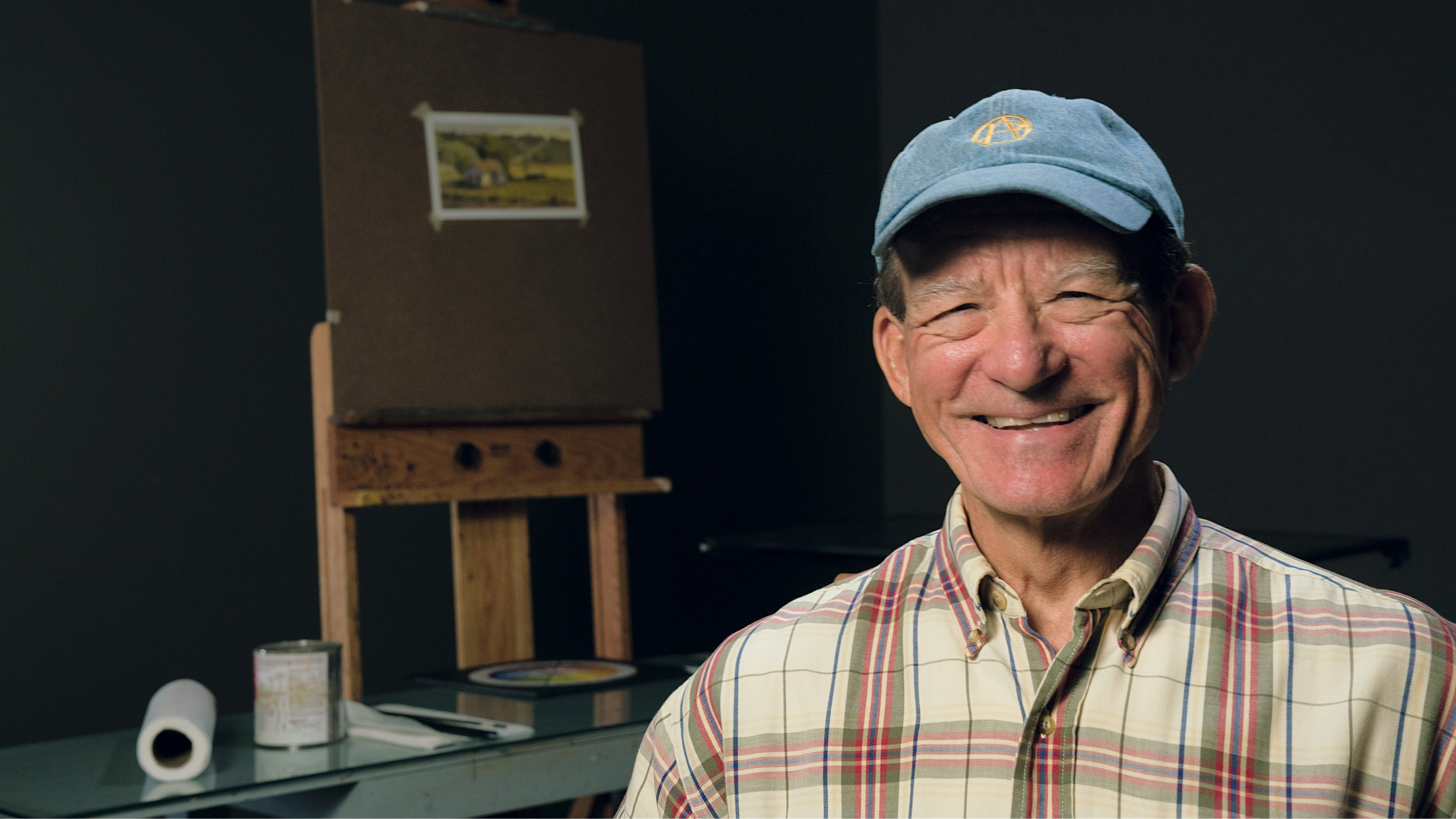
Meet Art Renewal Center Living Master John Pototschnik!
Born in St. Ives, England, John Pototschnik grew up in Kansas, in the American heartland. He has spent a lifetime painting the rural landscape he knows best. Farms. Small towns. Weather moving across open country.
He trained at Wichita State University and at the Art Center College of Design in Los Angeles, where he first understood that color is more than hue. It carries value and intensity as well. Then came 10 years in Dallas advertising as a freelance illustrator, and in 1982, the turn to fine art.
In those early years, John painted the way most artists do: with ten to 15 colors on the palette.
Around 1985, he met a Midwest painter named Bob Tommey, who worked with just three primaries.
John spent the next two weeks doing nothing but mixing color.
And the more afternoons he spent outdoors, the more he came to understand how nature actually behaves: what makes fog different from haze, how snow takes color from everything around it, what happens to contrast after the sun goes down.
That accumulated knowledge is what allows him to paint weather that isn’t in front of him.
It’s the reason he can put snow, fog, and moonlight into a brightly lit summer photograph, and the reason he can teach you to do the same.
He is a Living Master with the Art Renewal Center, a Signature member of Oil Painters of America, and a Master Signature Emeritus member of the Outdoor Painters Society. His work has appeared in PleinAir Magazine, The Artist’s Magazine,and Southwest Art. He has received the George Washington Honor Medal and recognition in Who’s Who in American Art, and has served as a speaker, juror, and past president of both Artists and Craftsmen Associated and the Plano Art Association.
He has written a weekly blog for more than a decade, and produced several best-selling books and courses with Streamline Publishing.
But what his students tend to mention first isn’t on that list.
Available in both Streaming and DVD Formats
Introducing John Pototschnik’s Brand NEW Oil Painting Course: The Three-Color Secret: Master Any Mood, Any Light
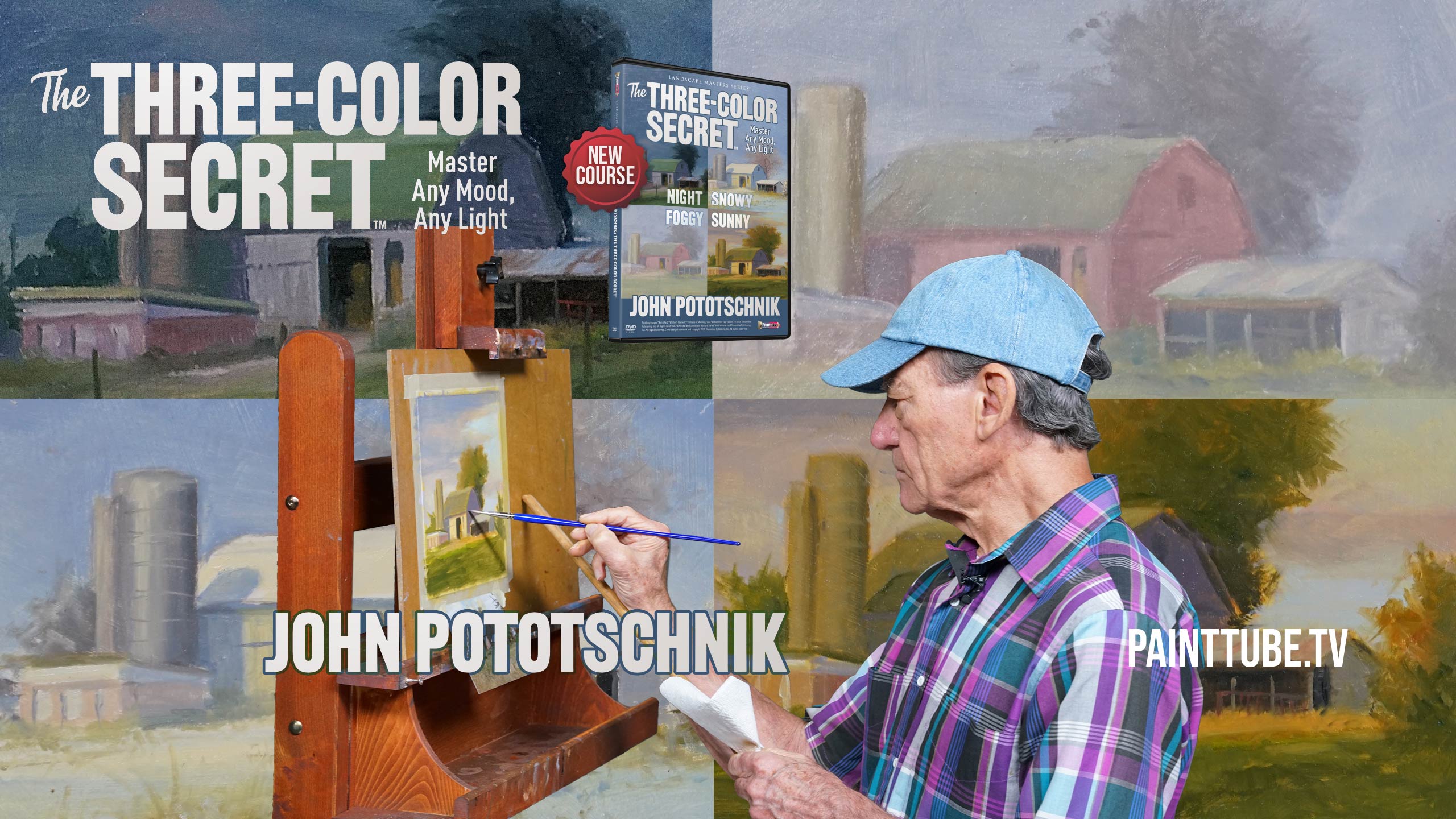
Inside The Three-Color Secret: Master Any Mood, Any Light, John Pototschnik proves something most artists never see demonstrated: the mood of a painting is a decision you make, not a condition you inherit from your reference photo, and not even what you see in front of you.
Golden hour. Moonlight. Snow. Fog. Same subject, same three primary colors, plus black and white.
These unique moods, lighting, and weather conditions were built from decades of watching how nature behaves, and from a value structure John chose before touching the surface.
- How to choose your mood first, then build the value structure that carries it before mixing a single color…
- Why the sunlit side of a barn at golden hour is far darker than you think…
- How to use Ivory Black as a dark blue — it’s the “forbidden” tube that makes fog silvery and nocturnes believable…
- Why snow isn’t white, and how it borrows color from everything around it…
- How to tone your surface so the color underneath supports your mood from the very first stroke…
- The clear-acetate trick for matching color and value against your reference, meaning no more guessing…
- Why the darks in fog are far lighter than in any other mood, and how to hold values that close together…
- …and so much more!
This course is perfect for:
- Landscape painters who feel trapped by what their camera happens to record…
- Anyone whose snow looks like white paint, or whose fog looks unfinished…
- Artists who have lightened a nocturne until it stopped being night…
- Anyone with a drawer full of paints who suspects the answer isn’t buying another tube…
You’ll instantly connect with John’s approachable, unhurried teaching style.
Join John Pototschnik in The Three-Color Secret: Master Any Mood, Any Light, and start painting the weather you intend, not the weather your photograph happened to catch.
He explains every decision as he makes it, breaking the process into simple, easy-to-understand terms, making this a must-have for any landscape painter who wants real command of mood.
Available in both Streaming and DVD Formats
Chapter Breakdown
Video Length: Over 5 Hours
PART 1: Setting the Stage
01 — Introduction
02 — Project Materials & Tools
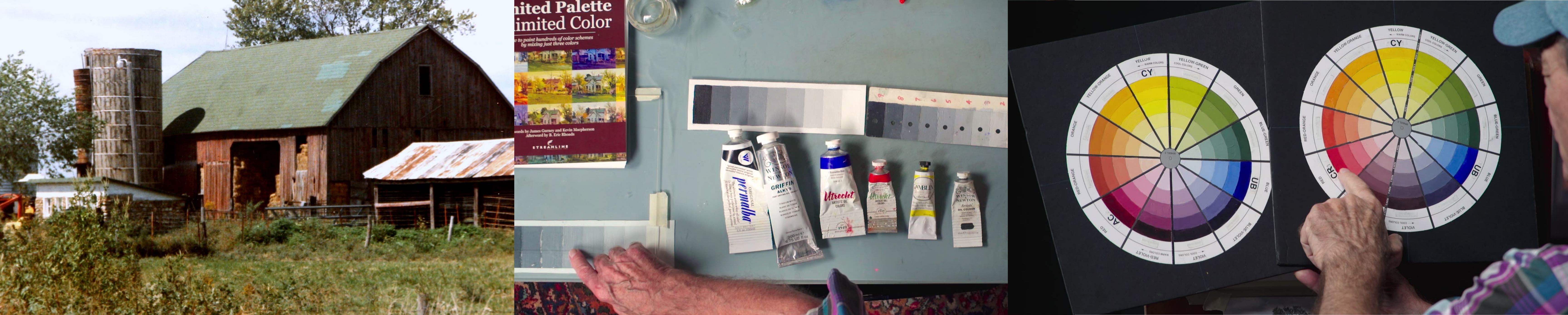
The paper and why he gessoes it. The five tubes: Titanium White, Ultramarine Blue, Cadmium Red, Cadmium Yellow Medium, Ivory Black. Brushes, palette knives, mahl stick, gray scale, and the clear acrylic sheet he lays over his studies to judge value. Plus the photo reference itself, and why he chose it.
PART 2: Four Painting Demos!
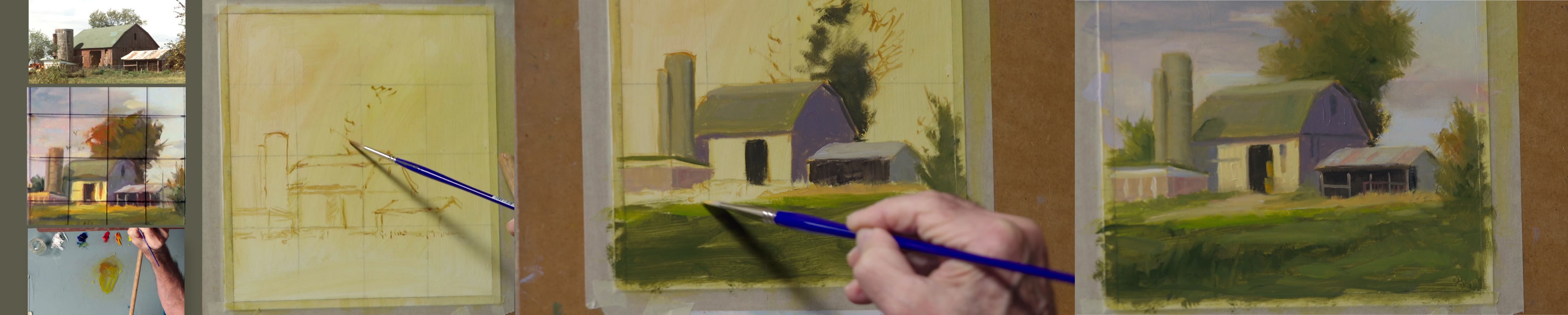
Demonstration One: Golden Hour
That last rich, warm hour of the day, when even the shadows hold color.
03 — Set the Tone
Mixing the main complementary colors, then toning the surface a reddish-green, chosen deliberately to support the mood before a single stroke of the subject goes down. It dries immediately, so you can keep working.
04 — Drawing
Drawing the subject with paint, using a grid on both the study and the surface. Perspective and horizon line for believable buildings. In this chapter you’ll draw along with John, taking the time to do it properly, because the rest of the painting depends on it.
05 — Color Mixing
Laying clear acetate over the reference to match color as you mix, then wiping it clean. Lighter or darker, warmer or cooler. Why can a mixture look brown on the palette and read green in the painting? And how to use black as a dark blue.
06 — Set the Shadows
Flat block-in of the basic shadow tones, to be modulated later for interest.
07 — Add Foreground & Midground
The foreground dark field, and the surrounding objects warmed by the low sun.
08 — Add the Sky & the Tree
A dramatic sky that is darker than you think. Warms against cools, subtle value shifts, soft edges, and smooth brushwork. The main tree is built with the same restraint.
09 — Work All Over
Bringing the painting toward a higher finish. The light side of the barn goes in here, and you’ll be surprised how dark “sun-drenched light” actually is. Shadows developed, highlights added to the buildings.
10 — The Odds & Ends
The final details and highlights that bring the scene to life.
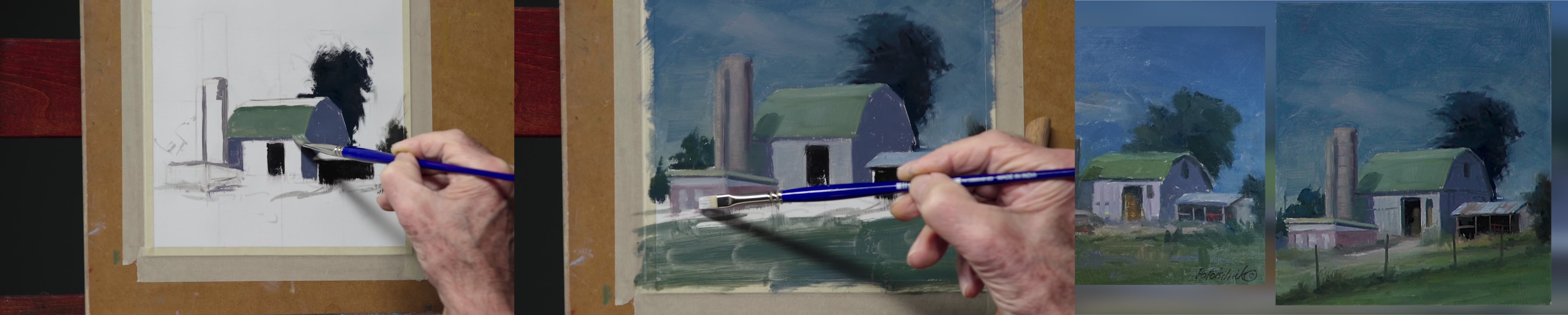
Demonstration TWO: Nocturne
A moonlit evening. The value range collapses, and shadow carries the mystery.
11 — Color Mixing
Building the night sky, which contains far more black than you’d expect, and mixing the shadow colors that hold the scene together.
12 — Lay In the Darks
Think dark, and skip the details. The white surface will lie to you and insist you’ve gone too far. You haven’t.
13 — Work Top Down
The sky first, with subtle clouds and color variation, then everything that reaches up into it. Color relativity does real work here: some objects must lift against the dark sky, others sink and match it.
14 — Block In the Foreground
The large expanse of grass, laid in early so every value that follows can be judged against something real.
15 — Finish the Midground
Covering the surface and developing the objects that carry interest, with dimension built from color and value shifts
16 — Refinements
Details and highlights — always remembering these are cool, dark, moonlit colors, low in contrast except where drama is intended. Including John’s guidance on fencepost heights.
17 —Final Touches & Adjustments
The last touches of dimension and detail that make the scene feel genuinely inhabited.
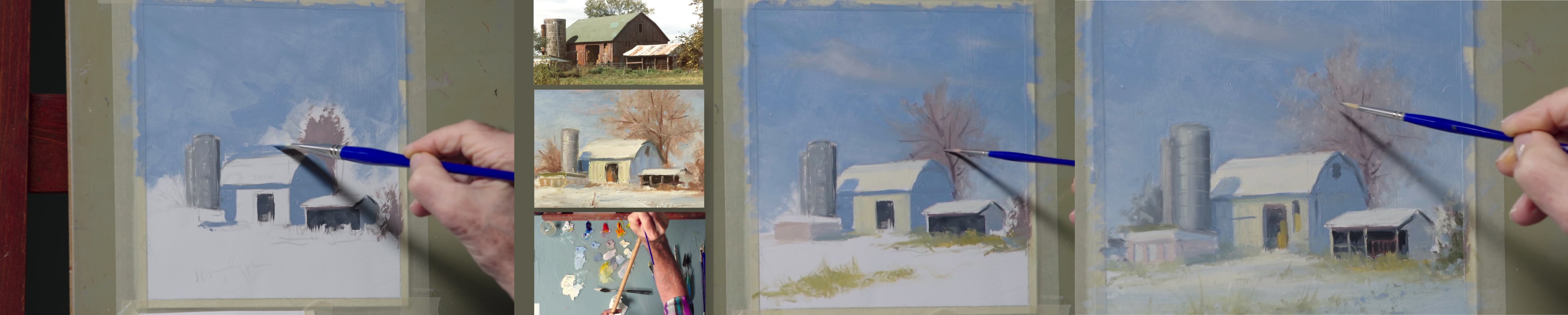
Demonstration THREE: SNOW DAY
Sun-splashed winter. And the key to all of it: snow is not white.
18 — Review the Subject
How to observe snow on location, and how to mix for it. Color from everything nearby reflects into snow, and snow throws light straight back onto everything in return.
19 — Lay In the Darks
Flat block-in of the basic shadow tones. Start simple, and watch color temperature closely.
20 — Paint the Sky
A smooth, even gradation from deeper blue overhead to lighter, warmer blue as you approach the horizon — laid in the way John prefers, without visible brushwork.
21 — Develop the Painting
Midground established, then foreground. The tree blending softly into the sky, wispy clouds melting into it. The barn turning through changes of angle with slight shifts of temperature and value. The main tree given solid structure inside soft foliage shapes, shrubs developed, foreground filled with reflected sky. Plus the five tools John uses to guide a viewer through a painting.
22 — Refinements
Adjusting value and color as more is added. Details, highlights, dimension — and the frosty haze that settles into the trees.
23 — Final Touches
Bringing dimension to a snowy field so it reads as ground rather than paper.
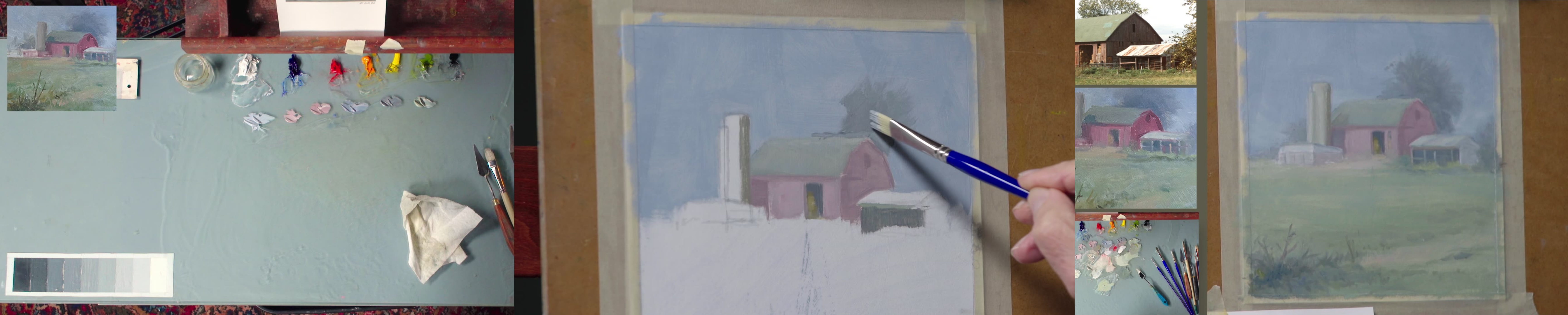
Demonstration FOUR: A FOGGY DAY
The most difficult of the four — subtle color, close values, delicate atmosphere
24 — Review the Subject
Why nearly every mixture wants a little Ivory Black in it to produce that neutral, silvery air. How to judge value when fog strips away contrast and detail.
25 — Work Top Down
Starting with the sky, which sets the tone for everything that follows. The darks here are far lighter than in any other demonstration, and the values sit remarkably close together.
26 — Develop the Painting
The first full pass across the remaining elements of the scene.
27 — Refinements & Final Touches
Watching for value and color adjustments as the painting fills in, and knowing when a subtle painting is finished.
28 — In Closing: Three-Color Secret
John makes the case for painting every kind of weather, every kind of “mood.” Not to produce framed work but to learn. As he shares samples of his paintings, you’ll be encouraged to explore and transform your work with endless possibilities!
EXTRA BONUSES
- Plein Air Painting Tips: John’s insights for painting outdoors and developing observation skills
- High-Speed View of the demo paintings for your learning convenience
- Exhibit of Works: Gallery set to music for your creative inspiration
- Insights from the Artist: John’s art career development and insights
What John Pototschnik Will Share Inside
The Three-Color Secret: Master Any Mood, Any Light
One Photograph, Four Weather Conditions: The Controlled Experiment
John Pototschnik does something most instruction never attempts. Rather than explaining that mood can be changed, he holds everything else still and proves it.
Same barn. Same tree, same field, same photograph taken on a brightly lit summer afternoon. Same three primary colors, plus black and white. Only the mood changes.
That’s what makes this course different. When the subject and the palette never move, you can finally see which decisions were doing the work all along: where the values sit, how wide the range runs, where contrast is allowed and where it’s withheld, which edges stay firm and which dissolve.
There was no snow that day. No fog rolled in. The moon never rose over that silo. The sun wasn’t setting.
Discover the “Mood First” Order of Operations
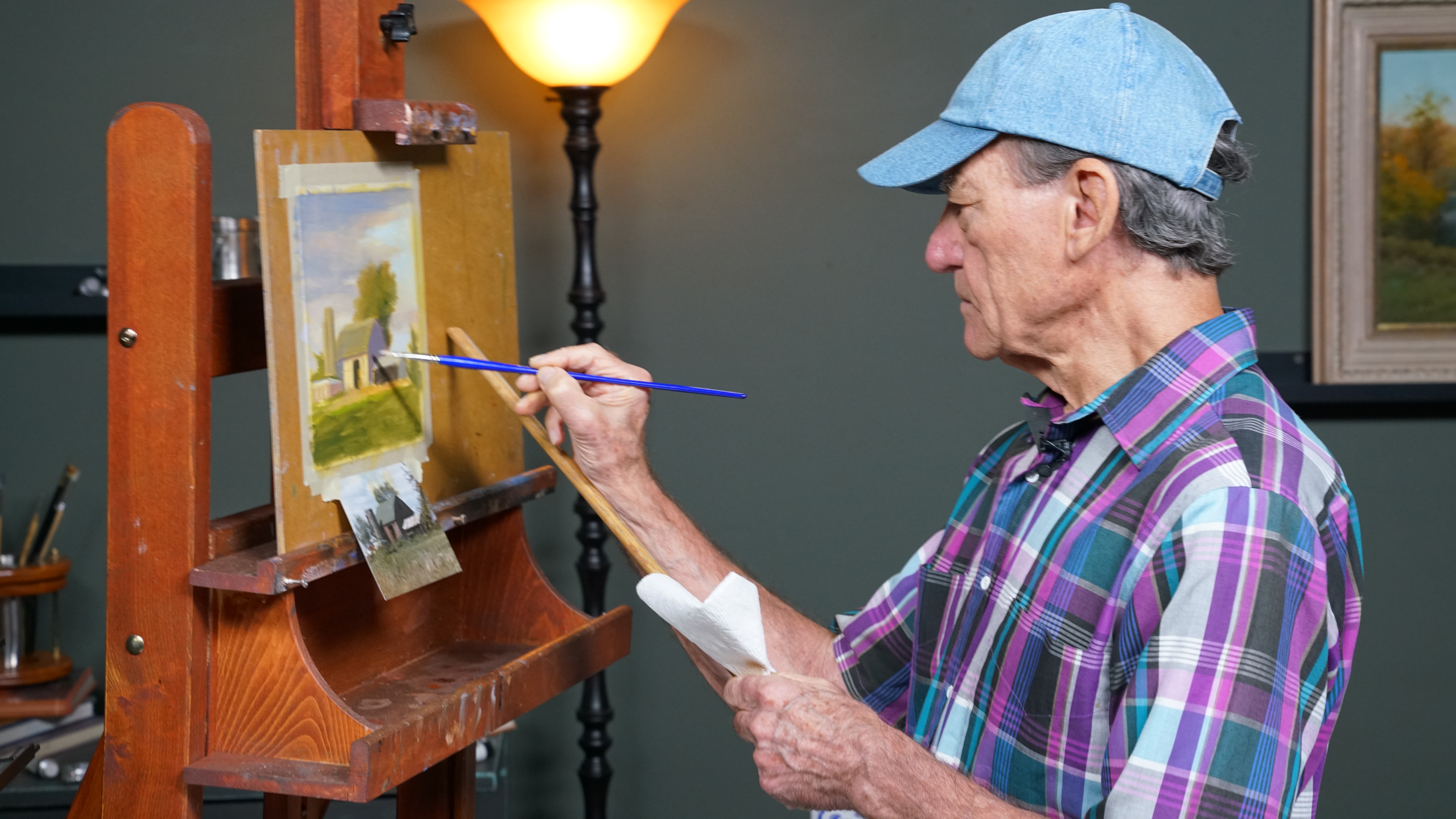
Most artists work in exactly the wrong order. They open a reference photo and begin matching colors, hoping the feeling arrives somewhere along the way. It rarely does.
Available in both Streaming and DVD Formats
Learn What Nature Actually Does, Not What You Assume
Most struggling landscape painters aren’t short on talent. They’re short on observation.
Snow isn’t white; it borrows color from everything nearby and throws light back in return. Fog doesn’t merely gray things down, it lifts the darks until every value crowds together. A moonlit sky holds far more black than anyone expects. And the sunlit side of a barn at golden hour is dramatically darker than it looks.
These aren’t opinions. They’re observations gathered over decades of painting outdoors in every condition, and they’re the reason John can put weather that isn’t in front of him onto a canvas.
You’ll also see the “forbidden tube” used properly. John treats Ivory Black as a dark blue, not as a way to darken color.
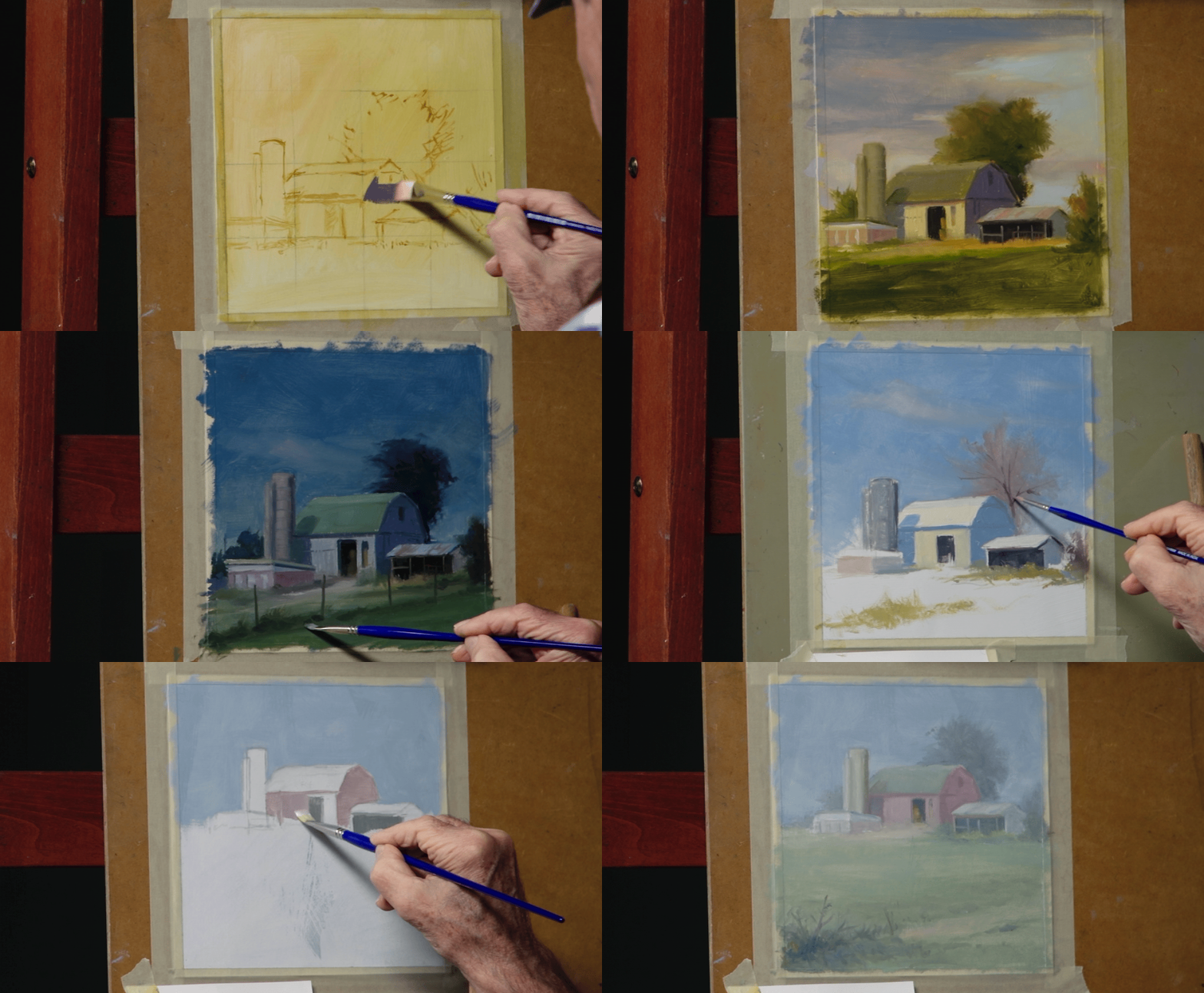
Here’s a small taste of what’s inside:
✅ How to decide the mood before you mix a single color. It’s the “backward” order of operations that changes everything downstream of it…
✅ Why the sunlit side of a barn at golden hour is far darker than you think, and what happens to your painting the day you finally paint it that way…
✅ How to turn a summer photograph into a snow scene, using color, value, and an understanding of how nature actually behaves…
✅ The truth about snow: it isn’t white. Color reflects into it from everything nearby, and it throws light straight back out onto everything in return…
✅ How to use Ivory Black as a dark blue. The tube you were warned never to touch, used the way a Living Master actually uses it…
✅ Why the darks in a fog painting are far lighter than in any other mood, and how to hold values that close together without the painting going soft…
✅ The clear-acetate trick for matching color and value. Lay it over your reference, mix against it, then wipe it clean…
✅ How to tone your surface to support the mood, including the reddish-green tone John chooses for golden hour, and why it works…
✅ Why is the sky in a sunset scene darker than it appears? One of the most common reasons paintings come out flat…
✅ Why your white canvas will lie to you when you paint a nocturne, and how to trust your darks anyway…
✅ The five tools John uses to guide a viewer’s eye through a painting (key lesson!)…
✅ How to draw with paint using a grid, plus horizon line and perspective tips that make buildings believable…
✅ How to paint a smooth, even sky gradation without a single visible brushstroke…
✅ How color relativity works. Why does the same mixture read brown on the palette and green on the canvas?
✅ How to paint frosty haze in winter trees, and give a snowy field real dimension instead of flat white…
✅ Why fewer tubes produce more color harmony. With only three primaries, everything must be intermixed…
…and so many more incredible insights and wisdom from a LIVING master!
Available in both Streaming and DVD Formats
Discover John Pototschnik’s Mood-Making Secrets in The Three-Color Secret: Master Any Mood, Any Light!

John has spent decades outdoors, watching how light and weather actually behave. That accumulated knowledge is what lets him paint a snowfall that was never there, and it is exactly what he hands you in this course.
Leap ahead with four demonstrations, leaving behind the maze of self-guided learning and incomplete YouTube videos.
You have a choice…
Persist in the old way. Match the colors your camera happened to record, buy another tube when the painting still comes out flat, and hope the mood arrives on its own…
OR…
Learn the “backward” order of operations from a Living Master. Choose the mood first. Build the value structure that carries it. Then let color bring it to life.

30-Day 100% Money-Back Satisfaction Guarantee!
After you go through this course, we want you to be completely satisfied and feel confident that you’ve improved your painting skills.
However, if after watching the video, you decide it’s just not for you, let us know within 30 days of purchase and we’ll refund 100% of your money.
Disclaimer
Results require practice and dedication. The techniques taught in this video need to be studied and implemented consistently to achieve improvement in your paintings. Individual results will vary based on experience level and amount of practice.
Experience The PaintTube Difference!
Enjoy Premium Art Instruction From The World’s Leading Artists
700+ step-by-step video courses so you can build your own custom curriculum and learn from home — at your pace.
PaintTube provides premium art instruction designed to help you learn faster and retain more, delivering Hollywood-quality, professionally produced, high-definition art instruction videos with extreme clarity, excellent sound, and perfect light.
Our painting demonstrations offer you extreme closeups and detail, with a better view than you could get in the first row of an in-person workshop. You’ll have clarity and understanding of each brushstroke, giving you the best art education ever.
FREE U.S. DOMESTIC SHIPPING ON ORDERS OVER $249 • LIFETIME ACCESS • NO SUBSCRIPTION
To your success!

Eric Rhoads, Publisher
PaintTube.tv
Though you can observe the techniques of any artist instantly by watching them demonstrate and by watching the videos repeatedly, please know that, though many artists offer insights that can help people overcome a lot of learning time, every artist learns at their own speed based on their own level of understanding. Painting and drawing bring great joy, though the joy may come from practicing various techniques over and over until you master them. We do not wish to indicate that you, or anyone, can skip the joy of practice and the challenges of getting better. Painting is a lifetime endeavor, and getting good does not typically happen rapidly, or instantly. Your results may vary. And please know that if at any time within 30 days you feel this video has not lived up to your expectations or its promise, we will happily refund your money.
